About Eric Litvin
A biography in four movements: the early years, the apprenticeship, the Sebastopol chapter, and what comes next.
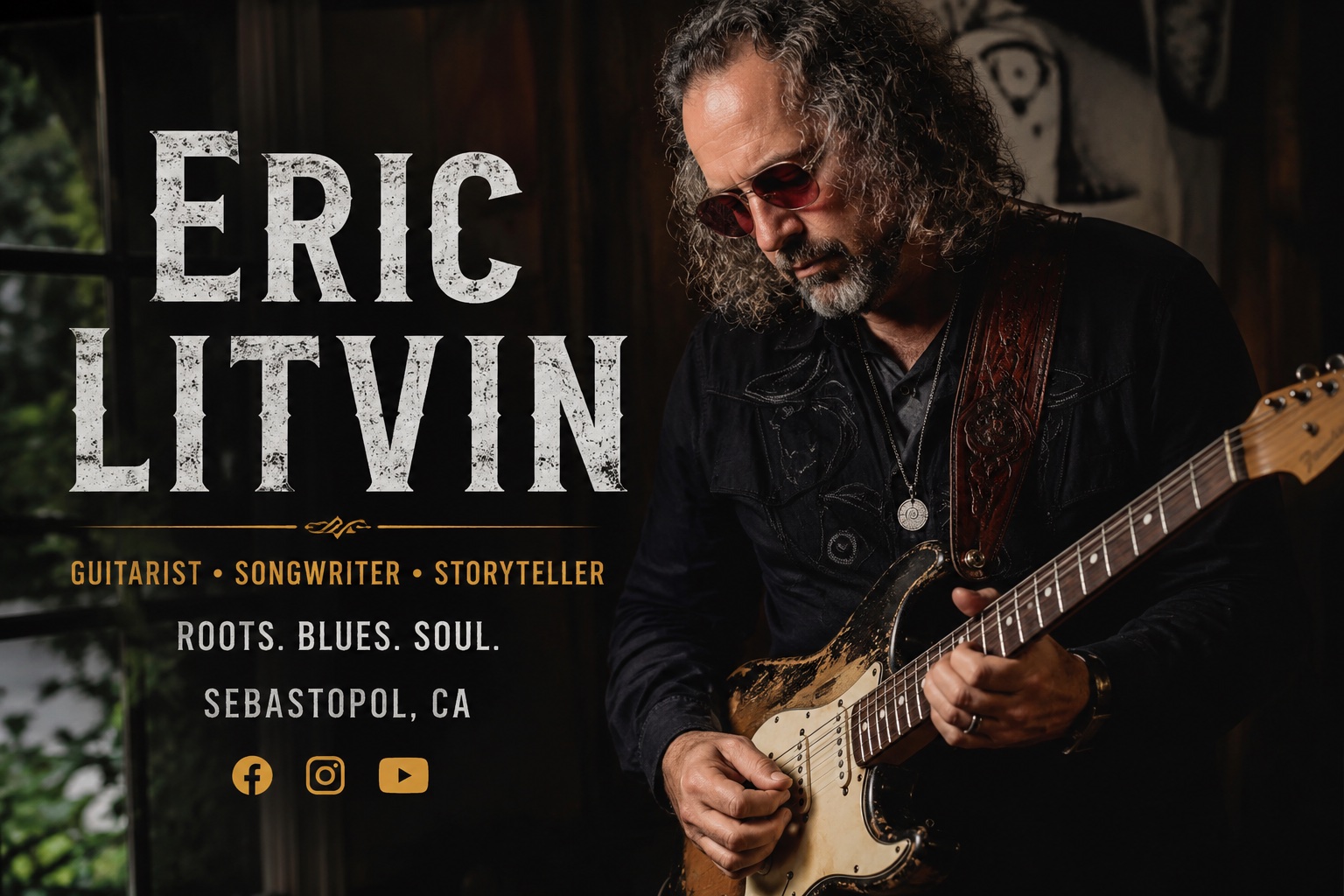
The early years
Eric Litvin grew up around music the way some kids grow up around sport — it was always on, always discussed, always a measure of something. He picked up the guitar [SUPPLY: early age, e.g. "at age nine"] and found almost immediately that the instrument had an answer for every question he'd been walking around with. That's a strange thing to discover as a child, but it tends to produce a particular kind of dedication.
His earliest influences were [SUPPLY: 2–3 broad genres or formative artists without invented names, e.g. "the blues and soul records his parents kept in heavy rotation"]. By his mid-teens he was playing out regularly, learning on the job what no amount of bedroom practice teaches: how to hold a room's attention.
The apprenticeship years
Music school came next — [SUPPLY: institution name or "a regional conservatory program"] — where Eric spent several years inside a curriculum that could just as easily have squeezed the joy out of playing. It didn't. What he took from those years wasn't theory as dogma but theory as vocabulary: a wider set of words for what he'd already been trying to say.
The real education, though, happened in the clubs and listening rooms of [SUPPLY: city/cities where early gigging happened]. Playing five sets a night to rooms of varying attentiveness sharpens a performer differently than any classroom. Eric left that period with calluses that would never fully soften and an ear for the moment a crowd decides to lean in.
Sebastopol
Sebastopol wasn't a compromise — it was a choice. Sonoma County has its own deep musical culture, and Eric found in it the space to pursue roots, blues, and soul on his own terms. The California landscape informs the music in ways that are hard to name directly: there's an openness here, a quality of light and distance, that shows up in the songs.
Original work has always been at the center. Eric's own recordings reflect a dual education: technically grounded, emotionally direct, and built around songs that want to be heard more than once. His songwriting process tends to start with a single image or line and work outward — an organic rather than architectural approach that has consistently produced work his collaborators describe as feeling finished rather than assembled.
The storytelling comes from the same place as the playing. Eric treats the stage the way a good storyteller treats a room — reading the crowd, earning the silence, and leaving something behind when the last note fades.
I got into music because it was the only thing I found that was simultaneously unlimited and honest. You can go anywhere on a guitar, but you can't fake it. The string either rings true or it doesn't. I've spent a long time chasing that clarity — in technique, in songwriting, in the decisions about what to keep and what to leave out. The blues taught me that. Soul music confirmed it. Sebastopol gave me the room to do it on my own terms.
Year by year
[SUPPLY: Year]
First guitar
Picked up the instrument at [SUPPLY: age]. Began playing informally at home, developing ear and instinct before formal study.
[SUPPLY: Year]
First live performances
Started gigging locally in [SUPPLY: hometown/city]. Open mics led to small venue sets; the real education in holding a room begins.
[SUPPLY: Year]
Formal study
Enrolled at [SUPPLY: institution]. Spent several years building technical vocabulary and harmonic foundation.
[SUPPLY: Year]
First recording
Released [SUPPLY: debut EP or single title]. Recorded at [SUPPLY: studio name], produced by [SUPPLY: producer name or "self-produced"].
[SUPPLY: Year]
Based in Sebastopol, California
Settled in Sebastopol, CA. Began building a presence in the Sonoma County and Northern California music community; roots, blues, and soul become the center of the work.
[SUPPLY: Year]
[SUPPLY: Milestone — album, tour, award, collaboration]
[SUPPLY: One or two sentences describing this milestone in non-invented, factual detail.]
[SUPPLY: Year]
[SUPPLY: Milestone]
[SUPPLY: Description.]
[SUPPLY: Year]
[SUPPLY: Most recent milestone]
[SUPPLY: Description. This should be the most current major project or release.]